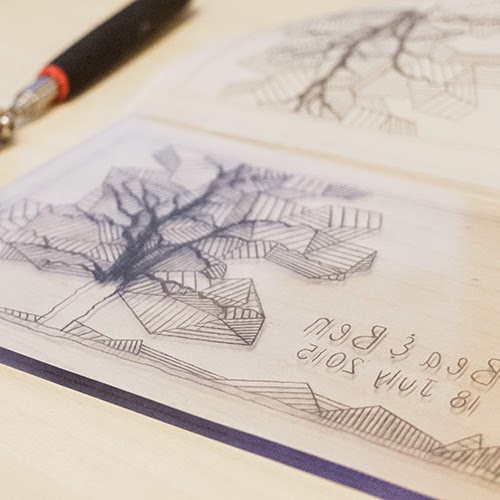
Showing posts with label printmaking. Show all posts

Oct 11, 2015

Linocut, S:t Johannes Kyrka (St. John's Church)

This will be an update with mostly process pictures of my first two-color reduction linocut, S:t Johannes Kyrka (St. John's Church).

Making this print was really challenging but also great fun, so I tried to photo and document everything. If you have any questions about any step or something I used, feel free to comment and I'll be happy to answer.

I've been drawing, carving, proofing and printing non-stop for the past two weeks, and the next week will be the last before the deadline for next year's Liljevachs Spring Salon (Liljevachs vårsalong). Background information: Liljevachs public art gallery was opened in 1916 as the first independent, public museum for contemporary art in Sweden. I am planning to apply with a couple of my original linocuts, including two new reduction prints featuring churches and rooftops in Stockholm.

S:t Johannes Kyrka is the first of the two and is the view of Vasastan roofs with the church's peaking Gothic tower. I've been going up to the roof park on Sveavägen to look at the amazing geometry; this linocut is my interpretation of it.

I started with a sketch in Photoshop. Here's what I learned: clipping masks work great when sketching for reduction prints. Nothing fancy at this stage - just messy doodle to show myself the overall composition and colors.


I did a quick transfer, tracing the outline (I printed it out to A3, same size with the block) and draw the details right onto the block. Here's me carving for the first layer. 

At this point I'm carving away what I want to leave white. 


First test proof of the lighter-colored layer. I'm making two editions, with this layer being red or yellow. 


I made enough prints of the first layer, in both colors, to give myself some margin for error in registration. Prints would hang to dry for 3 - 4 days before I print the second layer. 


This is the yellow one - a bright, rich color that really reminds one of the sunrise on a beautiful day. 
When the prints were hanging on the wire, I cleaned the block using baby wipes and baby oil, then started carving more from the block to prepare for the second layer. Here I'm carving away what I wanted to leave yellow/red. 


First test print! Apart from the dark color not saturated enough, I also marked with little stickers all the places I wanted to tweak before printing the final edition. Oh, also - you'll notice I signed this test print in Chinese :)


Printing the final edition :) Registration turned out great, and the dark color really made the lighter one pop.


Another angle - 


And the completed print, in yellow and dark gray (Sunrise), or red and dark purple (Sunset).

Can you spot the squirrel?

Some details on the print: 


Well, that's the print :) It's available for purchase in my shop here. Limited edition of 10 original linocuts for both colors; the design measures A3 and is printed on Hosho paper. 

Until next time!
/Tian

Sep 14, 2015

Blackbird & Rowanberries, Linocut

A couple of pictures to record the process of making my new linocut with a blackbird on a rowanberry branch. We had a blackbird nest in the garden this summer and we watched three eggs turn into beautiful birds.

Blackbirds come often to the rowanberry trees in our garden and this print is inspired by them.

Starting with a carving out linoleum - I'm using Jack Richeson this time. 

Prints hanging to dry. These are printed with Caligo oil-based ink on 200 gram Hahnemühle paper.

Hand-coloring the prints with watercolor. 

Getting to the leaves on the branch, mixing in yellow, blue to get different shades of green.

The print measures 23 x 30.5 cm (or 9" x 12") and the paper roughly 40 x 40 cm (16" x 16").
The print is available for purchase in my shop

Have a great week!

/Tian

May 24, 2015

Reeled In, New Linocut with Four Swedish Fishes

It took a while to complete this print - I was moving studios, and in a length pursuit in finding the perfect paper to print on, one that both looks great and is easy to tear into the cut/tear into the sizes I usually work with.

Luckily, everything was sorted out and I have two new linocuts to show you, Reeled In and Trotty. I'll put some pictures of the making of the first one now, and then make another post about the bird print.

This print features four Swedish fishes: abborre (European pirch), alaska pollock/torskfisk (a kind of cod), sjurygg (lumpfish or lumpsucker) and gädda (pike). It started - as usual - with a pencil sketch. I've been quite happy with this A4-sized lino and I've been sketching on printer paper. I transferred the outline to the lino with carbon paper, then started drawing the details with markers.


Onto carving. I've been making the stamps during weekdays and carving linoleum over the weekend, so this usually happens on our coffee table.


Our fluffy friend has taken a special interest in this linocut.


After a few morning's carving, the fish completed is ready for proofing. I am rolling on a generous layer of the Caligo oil-based ink to get a nice rich black especially on the sjurygg. Look at the velvety ink!


Here's the first proof. I marked the places that need a little tweaking. This is A4 printer paper. 


Printing the final edition on handmade mulberry paper. It's very light but has strong fibers and beautiful texture. 


This metal postcard mobile has been very helpful for drying prints! I taped little paper pads on the toothy clamps to protect the printing paper. 


A close-up on the pike. 


So, here's the completed print! Blogger has been doing bad things to my photos' white balance and brightness and I've been thinking about building a Wordpress site that incorporates my portfolio site and this blog. If only there was 48 hours in a day! :)

Anyway, this is a limited edition of 10, all hand-printed and signed at the bottom with the edition number. You can purchase it in my shop; and in my next post I'll share the process of Trotty, a smaller print with a white wagtail.

I also post a lot of photos of what goes on behind my work on my Facebook and Instagram, so head over and perhaps say hello! :P

/Tian


Apr 6, 2015

New Logo & Portfolio Site

If the path to become a successful artist is like climbing a mountain, I feel like I've just built my base camp. I purchased gantian.se a while ago and have been building my portfolio site one brick at a time, and now it's on!

So, take a look - if you see something that looks weird or spots a spelling mistake somewhere, I would love to know - I might have been working on this long enough to develop a blind spot or two :) 


I completed the logo before the website and have grown quite into it since. My Chinese name is 甘甜(ɡān tián, family name and then given name), which also happens to be an adjective meaning sweet

I wanted to incorporate my name in the logo without it looking too Chinese. Starting with a few basic pencil sketches, I decided to try out different colors, fonts and layouts in Photoshop instead. 


I did some crowd-sourcing on my personal FB page (thanks, guys!) and finally decided to go with the first one. To my eyes, it's the most interesting design of all four, but why stop there? Or, what's a printmaker without a handmade logo?

I carved out the design with the 甜/tian in two different boldness so I have more to work with digitally.


I scanned the imprint, cleaned it up a little, duplicated the right part and added color in Photoshop - bright red and blue combined with a very dark gray.

I made a vertical and a horizontal logo for different purposes. Right now on my portfolio site I'm using the horizontal design above the top navigation bar. 


Et voilà! You'll find process photos on my portfolio page with some other logos I designed. If you like what I do and would like me to be a part of a project you're working on, get in touch: email me, or use the contact form on the right :) 

Happy Easter!
/Tian

Mar 8, 2015

Dead Astronaut Ex Libris, stamp

In my last post I wrote and put pictures about how I sketched for the custom dead astronaut Ex Libris stamp; in this one you'll see how I carved it - with my Pfeil gouges fresh from Switzerland, which are probably the best things I've bought in a while.

I transferred the design to a piece of Speedy Carve; the design measures just under 8 x 6 cm. I had to test the new gouges (the ones with mushroom-like handles) on a small piece of rubber (top left) first to get myself a little familiar with them, but their blade is so long, smooth and round to the touch, and they are very nice to hold. They are all wonderfully sharp and leaves perfectly clean cuts in the rubber. I'm pretty sure I'll abandon my old gouges once I save up some money to buy the Pfeil in more sizes/models.

I also color-coded the two small gouges (a V and a U) with marker pens. Look very nice too I think.


I had a woodcut-like effect in my head so I wanted to use the gouges as much as I could. I ended up only carving the name and the UFO (it's just too small) with the scalpel (white one). 


The stamp took me about 2 hours to carve - almost non-stop. Sketching took longer, which usually is the case with custom designs like this. I've not been happy with my new office chair, but I've just ordered a Mabef desk easel so hopefully it'll give my neck and back an easier time 

Here's the completed stamp! (And the Pfeil knives are just so beautiful, aren't they?)


Here's a bigger image with more details. It's one of my favorite works so far, and the whole communication with Franz, the sketching and carving was just so much fun.

If you'd like to order a custom Ex Libris stamp too, feel free to contact me using the form on the right :) I love commissions like this. 


Greetings from a dead astronaut far away! 

Jan 20, 2015

Rubber Stamp Carving Material Review - Blüm and Moo Carve

So this will be the review I know you've been waiting for - the awesome glass-looking Blüm Clear Printmaking Blocks. I used it for recent block for a wedding invitation commission. I will also mention the more popular Moo Carve towards the end of the post. 

You can see their packaging in one of my previous posts; I got my from Blick Art Materials

* I'm not writing this review for any company; nor did I receive the products from any supplier. If you would like me to review a product, just get in touch! Head to the contact form on the right or email me


The Blüm printmaking blocks looks just like glass. They are very relatively thin - 1/8" (32mm). It feels like rubber, but is very smooth and completely clear. They come in packs of two and are quite affordable.

This is how it looks after the transfer (I use 2B mechanical pencil on acid paper to trace my digital design). The Blüm block takes the transfer better than most other materials. The smooth texture is a down size though, since it leads to more smudges. When I carve, I put a piece of tracing paper under my carving hand and on the carving block so I don't smudge the design. 

* I understand you are not supposed to use the Blüm clear block this way. It's clear for the reason that you can put an image right under it and carve - without tracing. It might work for less intricate designs or when some imprecision is acceptable, but with more detailed designs like this one, the thickness of the material would definitely get in the way.


You can see the tip of the scalpel when you carve! It feels very weird and takes a little getting used to. It is a bit difficult to see where you carve, and it's a good idea to carve the block on a light-colored surface. 


The lines in the bottom center of the picture above are not photoshopped - they are little air bubbles that shape between your two carved lines. I found them quite cute :3

The Blüm block is harder to carve than regular carving materials like Speedy Carve, and because it's rather rubbery and very stretchy, you kind have to give each piece a little help when you carve them out. This also makes it quite time-consuming to work with.


The trick part is carving away the extra parts with a gouge. Since gouges are usually thicker than scalpels, it's much hard to carve with them than with scalpels. But it's so pretty, and you can really feel how sturdy and flexible the completed block will be. 


Can you believe I cut myself with the gouge twice carving this block? That's how hard the Blüm printmaking block is. I carve at least on three days every week, and usually this happens less than once a month. 


Back to the block. Because of its thickness (or thinness, to be more exact), you can easily trim off the edges with scissors. 


To test-print my new block, I used Brilliance Graphite Black ink pad and printed on 250 gram cardstock. 


You can clean the Blüm block very easily if you use a water-based ink; just wash it with your hands under running water. There will be very little ink residue. Big Plus. 


It was a bit hard to carve, but when I ship the block to its new owner I knew they'll have something that'll last for years to come. However, if you make stamps or blocks for other people who are not familiar with printmaking, make sure you explain the printing and registration process to them before they get frustrated trying to use it like a regular rubber stamp. 

So, here's my verdict on the Blüm Clear Printmaking Blocks: definitely don't buy them if you are a beginner, but they do make very durable blocks that prints beautifully crisp designs, and they are super easy to clean. Try them out - they won't cost a fortune - and see how it goes!

By the way, you might remember a big piece of Moo Carve I had on my desk in my previous blog post. I did try it out, but I knew I wasn't going to write a full review like this, so here's a few words. 

Moo Carve is very, very easy to carve. Hot knife through butter. The slightly grainy texture feels great. 

There is just one down side: it breaks. 

Moo Carve is extremely soft and you can easily break a smaller part with you finger. That's right, with your finger. I wanted to try it for a custom stamp I'm making, and halfway through it just broke on me. Like so: 


I'm not sure if the company just went to far in the development of an easy-to-carve product, or if this is a family-friendly carving product that's supposed be used and thrown away. At about the same price you can get Speedy Carve - which isn't as soft but is nevertheless quite pleasant to carve. And your stamps can last years, instead of minutes. 

I'm constantly looking for new carving material! After this week's stamps, I will take a break and make 2 small prints. What do you want me to write about next? :)

Dec 22, 2014

Hand-printed wrapping paper

I had been toying with the idea of stamping my own wrapping paper even before I found out we were going to have a big family Christmas dinner that presumably involves a gift pile under a proper tree. Then I realized if I was ever going to print some wrapping paper, this would be the Christmas to do so.  

rubber-stamp-print-diy-wrapping-paper
This would be your standard magazine shot. 
Upon request, Anton dug out a huge roll of kraft paper from the garage. I wan't sure how lighter colors would show on the paper, so I decided to keep it simple and print in black. We ditched the idea of making regular snowflake or deer head stamps and went with 1) two stamps of our beautiful faces and 2) a smaller stamp saying God Jul (Merry Christmas in Swedish). 

The smaller stamp gave the final result a modern and chic feel and made us seem less like narcissistic brats who give our presents covered with only their faces. 

Oops. 

Anyway - I made all three stamps one morning, went home and we started stamping away. 

hand-carved-custom-portrait-personalized-rubber-stamp
You talking to me?
Our gifts vary quite a bit in size, so I printed the stamps closer for smaller gifts and further apart for bigger boxes, using both Brilliance's Graphite Black and StazOn's Jet Black to print the wrapping paper. Brilliance is very easy to clean with just water while StazOn is an archival ink that will stain your stamp, unless you use their stamp-cleaner. I don't recommend mixing these two kinds of ink pads if you want to keep your stamps all clean and pretty, but ink residue on my own stamps doesn't really bother me. 

rubber-stamp-print-diy-wrapping-paper
Printing this wrapping paper can be quite mesmerizing. 
It was a nice & sunny day - which you don't see a lot this time of the year here in Stockholm - and couldn't resist bringing these out to the garden and have a magazine-worthy photo session. The afternoon sun was low and warm but there were still traces of new-fallen snow on the terrace. 

Printing enough wrapping paper for our presents (including two other that we wrapped the second day) took less than 30 minutes; I don't think our presents could look any better. 

Tie these babes up with some twine for a rustic finishing touch. Or not.
If you have any questions about the process, leave a comment below, or head over to my Facebook page and stay in tune with my creations. 

Want to get printing, but still looking for some personalized rubber stamps? I'll make one for you! You can find geeky, cute and classic designs in my shop, or commission one by emailing me today. 

rubber-stamp-print-diy-wrapping-paper
Got some red and green from our trees too. 
Happy holidays! :)

/Tyr